
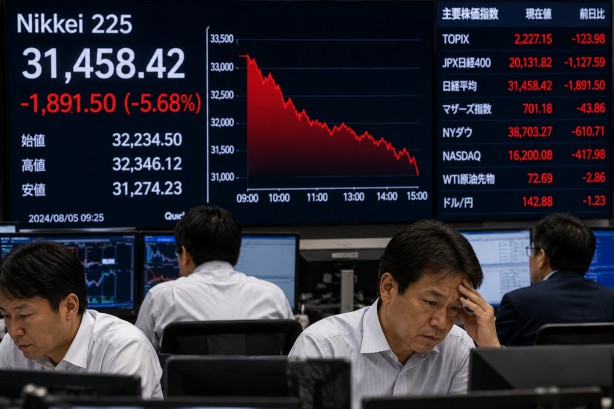
Friday saw Asian stock markets take a significant hit, with Japan’s Nikkei 225 index experiencing a notable plunge, leading the downturn. The Nikkei dropped by 5.8%, closing below the 63,000 threshold, largely driven by substantial sell-offs in technology and artificial intelligence-related sectors that unsettled investors.
Accompanying Japan’s market woes, Taiwan’s stock market fell by over 5%, while Hong Kong’s Hang Seng index saw a 2% decrease. China’s Shanghai Composite was not immune to the trend, declining by 1.6%, and Australia’s S&P/ASX 200 slipped by 0.7%. This widespread retreat in tech stocks comes amid rising concerns that valuations in the AI sector have escalated too rapidly. Investors are increasingly skeptical about whether demand for high-end chips and memory products will sustain if AI does not yield the anticipated profits and efficiency improvements.
Across the Pacific, the United States’ Nasdaq Composite also faced challenges, dropping 1.5% on Thursday. The decline was influenced by significant losses among leading chip manufacturers. Nvidia, for instance, fell by 2.4%, and similar declines were noted for Micron Technology, SanDisk, and Western Digital.
Amidst these fluctuations in the stock market, oil prices witnessed an upswing as escalating tensions in the Middle East raised alarms about potential disruptions in global energy supplies, especially through the critical Strait of Hormuz. In response, Brent crude oil climbed by 1.1%, reaching $85.13 per barrel, while the US benchmark crude increased by 1.3%, closing at $79.95 per barrel.