
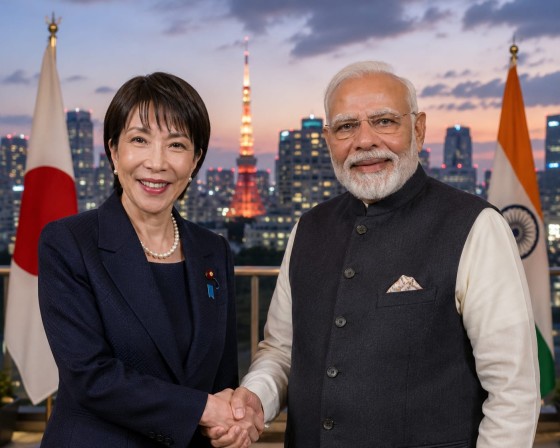
In a bid to bolster security and technological collaboration, Japan and India have pledged to enhance their partnership following a high-level summit in New Delhi. Japanese Prime Minister Sanae Takaichi and Indian Prime Minister Narendra Modi held discussions that resulted in commitments to advance cooperation in areas such as economic resilience and cutting-edge technologies.
The two nations underscored the importance of maintaining a free and rules-based Indo-Pacific region, voicing concerns over economic coercion and the situation in the East China Sea and South China Sea. They emphasized the need to fortify supply chains, especially in critical sectors like semiconductors and essential minerals, to ensure strategic autonomy and resilience.
In the realm of defense, Japan and India plan to expand their military collaboration by conducting more joint exercises and improving cooperation on the maintenance of naval vessels and development of defense equipment. A significant step in this direction will be the convening of a “two-plus-two” meeting involving their foreign and defense ministers later in the year.
Economically, the summit witnessed the signing of 129 memorandums of understanding between Japanese and Indian companies, marking investments amounting to approximately ¥2 trillion ($12.4 billion). These agreements span across sectors such as semiconductors, artificial intelligence, automotive production, and advanced technologies, showcasing the robust economic ties between the two countries.
Furthermore, Japan and India have set a goal to strengthen their collaboration in the field of artificial intelligence. By 2030, they aim to bring 500 Indian AI specialists to Japan to facilitate joint research and innovation, highlighting the increasing synergy in emerging technological domains between the two nations.